
Review · USA
Seward: Stoney Creek Canopy Tour with Zipline
The best part of this Seward adventure is the changing route. You begin high along the valley wall with a view toward glaciers, then move through darker forest, across bridges, and down toward the road. I especially like the 1,100-foot zipline over a reflecting pond and the two rappels, which give the course more variety than a simple zipline ride.
I also like the small group, limited to eight people, and the careful ground-school practice before anyone leaves the welcome center. The main drawback is that this is not a casual sightseeing ride. You need to raise both arms fully above your head, handle heights well, and be comfortable with a harness, rappels, and rain.
Key points at a glance
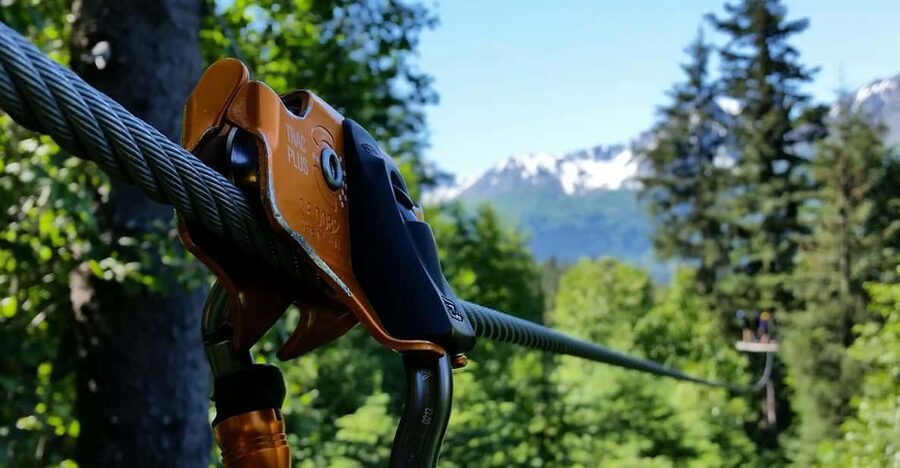
- Eight ziplines with changing views: Start above the valley, then descend through thick Pacific forest.
- A 1,100-foot forest traverse: The longest described line crosses the valley wall, passes over a reflecting pond, and lands 75 feet up a Sitka spruce.
- Two rappels add real variety: You descend 60 feet partway through the route and 40 feet near the end.
- Three suspension bridges: One aerial walkway rises from near ground level to 60 feet above the forest floor.
- Small groups of no more than eight: The format gives guides room to teach and help each person.
- A serious activity with clear limits: The course is not suitable for children under 10, pregnant women, people with back problems, or anyone outside the 88 to 270 pound weight range.
Starting at the Seward small boat harbor
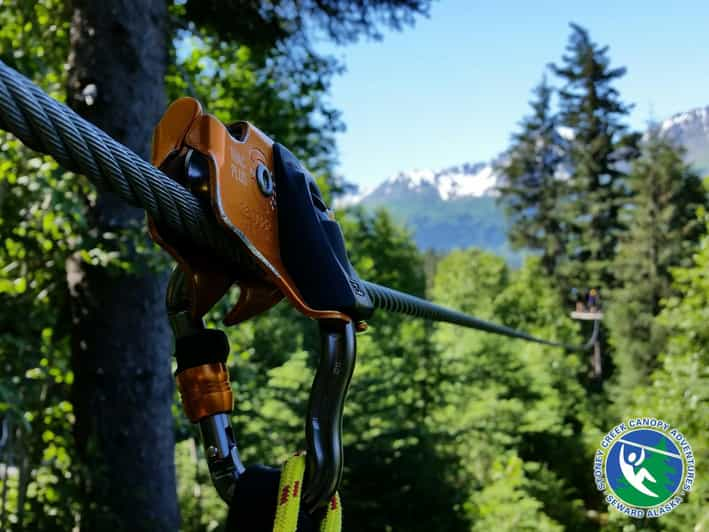
Your outing begins at the Adventure Center in the Seward Small Boat Harbor. From there, a Stoney Creek Canopy Adventures van carries you to the course. The van leaves promptly 30 minutes before the scheduled tour time, but you are asked to check in at the office 45 minutes before departure.
I would treat that 45-minute arrival time as firm. You do not want to be searching for the Adventure Center while the van is preparing to leave. The whole experience lasts about 2.5 hours, so it can fit well into a Seward day, but you should leave enough space around it for the early check-in and transport.
The course welcome center is easy to remember. A large yurt sits in a tree above the ground, giving the arrival area a playful Alaska character. It is also where you meet your guides, store permitted belongings, and prepare for the activity.
The small group limit matters here. Eight people is large enough to share the fun, but small enough that instruction should not feel rushed. The guides fit each person with a helmet and harness, explain how to ride and brake, and run practice exercises on the ground before the forest section begins.
That practice is more than a formality. The first zipline is short, but you will enjoy it more if you already know how to hold your body and control your speed. The guides are there to move the group through the course, but you still need to follow instructions and take an active role in your own safety.
More Canopy Tours in the USA
- Big Island Kohala Canopy Zipline Adventure
★ 5.0 · 720 reviews - Ketchikan Shore Excursion: Rainforest Canopy Ropes and Zipline Adventure Park
★ 5.0 · 390 reviews - Minnesota River Valley 14-Line Thrilling Zipline Canopy Tour
★ 5.0 · 304 reviews
Riding upward to the first platform
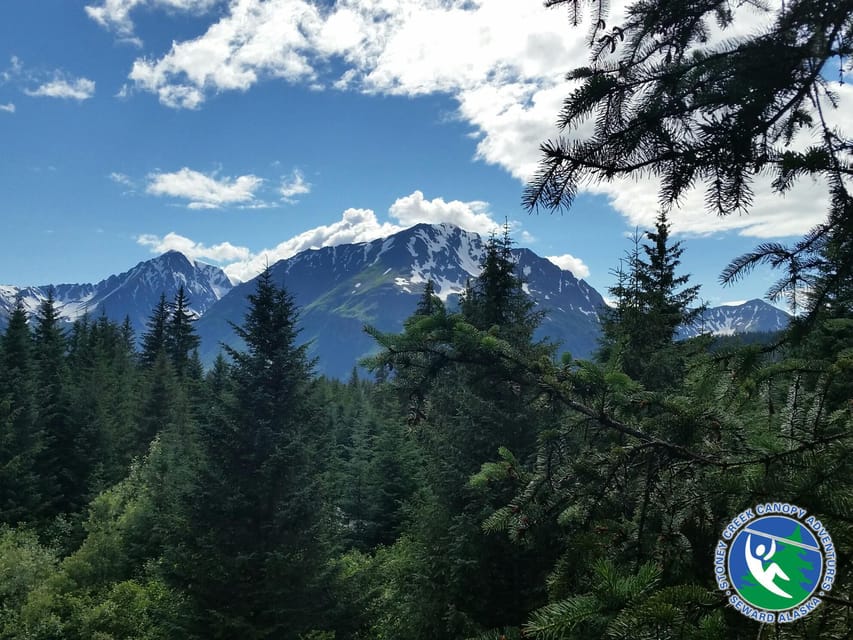
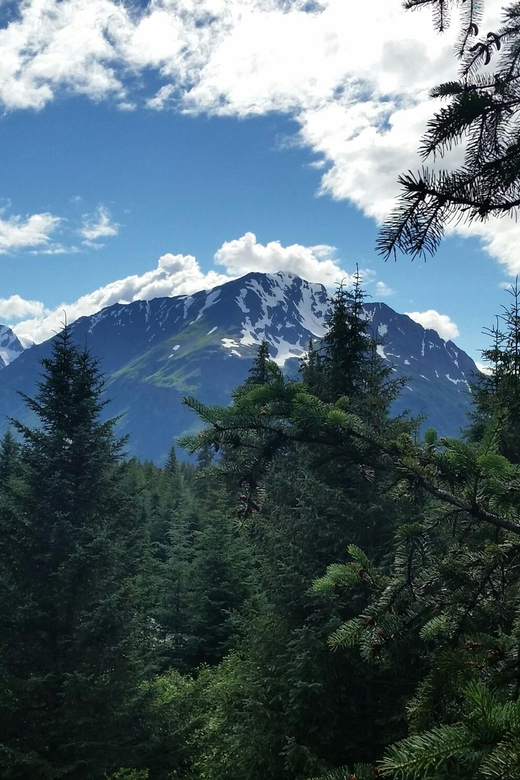
After ground school, the group rides farther up the valley on a forest road. A short walk leads to the course entrance and the first platform. From this high point, you can look across the valley toward mountains and glaciers to the southwest.
This opening view gives the tour its strongest sense of place. You are not simply riding a zipline in an enclosed adventure park. You are looking out over Stoney Creek’s forested valley, with glacial country visible beyond it.
The first line runs only 65 feet across the fall line and stays fairly close to the ground. That may sound modest compared with the longer lines later, but it is a smart beginning. You can get used to the harness, cable, platform, and braking technique without starting with a long flight above the trees.
The route then builds gradually. The third zipline travels 190 feet and ends 50 feet up the trunk of a large Sitka spruce. The change from the low opening line to a high tree platform makes the course feel more adventurous without throwing you straight into its biggest challenge.
The numbered descriptions do not spell out every detail of all eight ziplines, so you should think of the course as a sequence of forest crossings rather than a set of identical rides. That variety is one of its strengths. You keep changing height, direction, and surroundings.
The 1,100-foot line over the reflecting pond
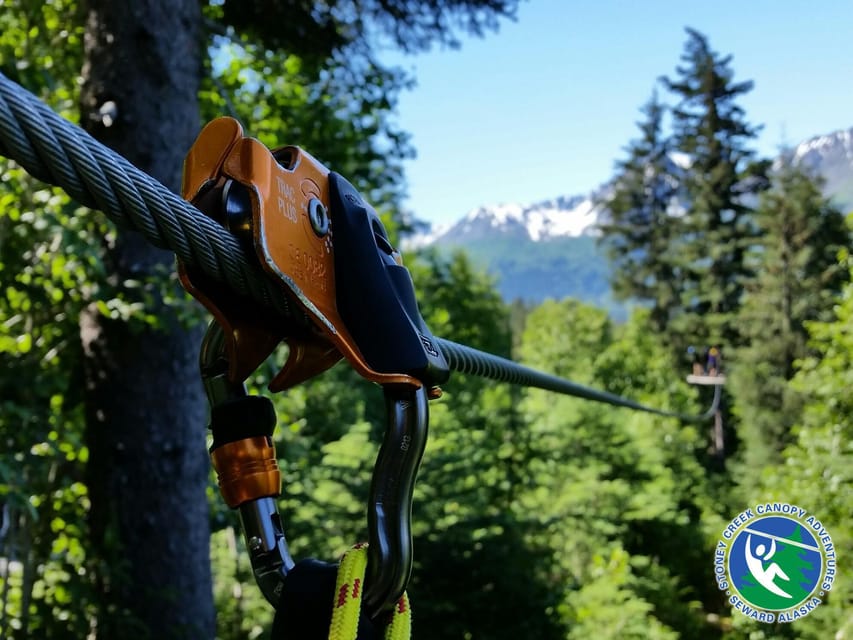
The fifth traverse is the signature section. It runs 1,100 feet above the trees along the valley wall, passes over a reflecting pond, and finishes at a platform 75 feet up another Sitka spruce.
This is where the scenery and the activity work together best. The length gives you time to take in the forest instead of merely launching and stopping. The pond adds a clear visual marker below, while the elevated platform puts you well above ground level when you arrive.
You should also expect this line to feel more exposed than the first few. People who are comfortable with heights will likely find that exposure exciting. If you already know that looking down from a tall platform makes you uneasy, this course may push past your comfort zone.
The route is not designed around speed alone. Its appeal comes from the changing views and the way each platform connects you to a different part of the forest. You move from open valley views to tree-level travel, then toward thicker vegetation.
Entering the darker Pacific forest
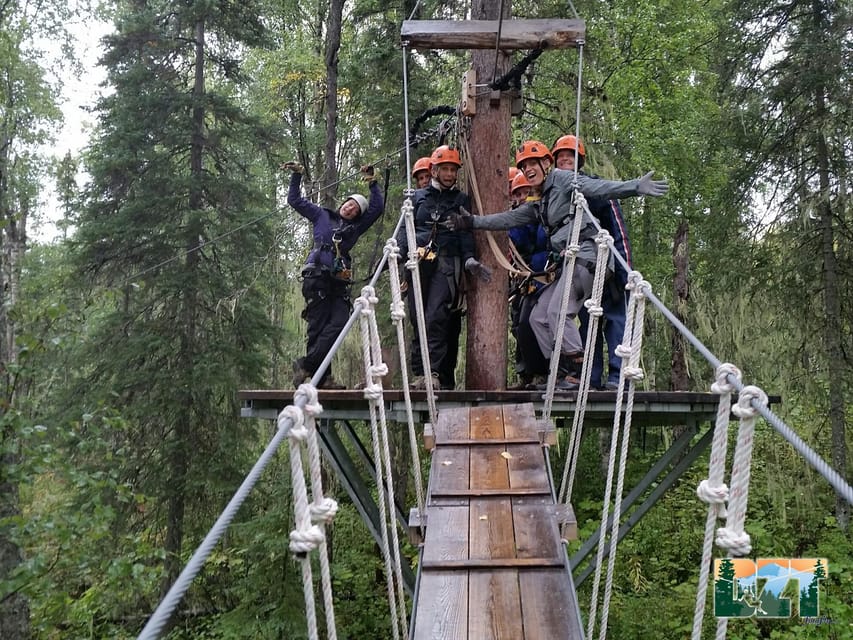
After the high valley section, the route descends into denser and darker rain forest. The forest includes huge Sitka spruce and mountain hemlock, with creeks running through the vegetation. The shift in mood is noticeable. The first part gives you broad views, while this section brings you close to trunks, branches, mossy ground, and water.
A 600-foot zipline carries you into an enormous mountain hemlock. Another shorter line runs at mid-level through the forest. This is also an area where bald eagles have often been sighted, though an eagle is not guaranteed during your visit.
That is worth keeping in perspective. The tour is about moving through the forest, not waiting for wildlife. If you see an eagle, it will be a bonus rather than a planned part of the schedule.
The forest section may be especially appealing if you want more than a thrill ride. You get a sense of the structure of Alaska’s Pacific forest, from high spruce platforms to shaded ground-level paths and sparkling creeks. The ziplines provide the motion, but the setting gives the experience its identity.
Same harness, a different kind of thrill:
- Koloa Zipline in Kauai
★ 5.0 · 6,764 reviews - Oahu’s North Shore: 8-Line Zipline Adventure
★ 5.0 · 3,616 reviews - 7-Line Zipline Experience in Sevierville
★ 5.0 · 2,872 reviews - 7-Line Maui Zipline on the North Shore
★ 4.5 · 1,648 reviews
Two rappels and three bridges
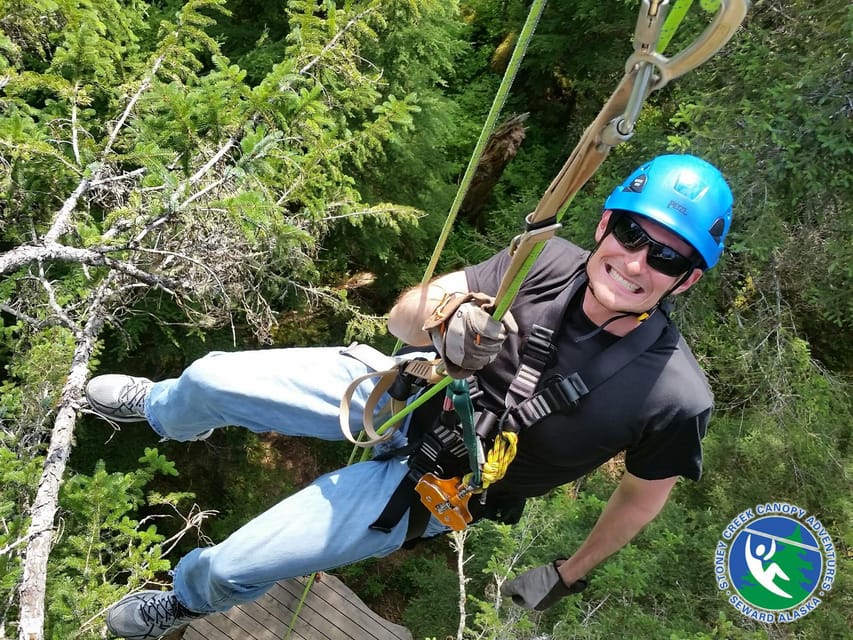
One of the course’s most useful features is its mix of activities. After arriving on a landing platform, each person rappels 60 feet down to the entrance of an aerial walkway.
The rappel is controlled and vertical, not a zipline flight. It asks you to trust the equipment and follow the guide’s directions while lowering yourself toward the next section. If you prefer an activity that keeps you moving from one cable to the next, this pause may feel slower. If you enjoy variety, it breaks up the rides in a good way.
The aerial walkway begins just above the ground and ends 120 feet later at a point 60 feet up another Sitka spruce. The height changes as you cross, so it is not simply a flat bridge between two platforms. You gain elevation while walking.
The route then turns 90 degrees and crosses a longer bridge to a hemlock. From there, zipline riding begins again. These bridges make you pay attention to the forest around you in a way that a fast cable crossing does not.
The course includes three bridges in all. The provided route details explain the aerial walkway and the longer bridge, while the third is part of the overall canopy layout. Together, the bridges add balance to the eight ziplines and give you short stretches where you can look around rather than focus on landing.
Descending toward the road
Later, a 280-foot line travels toward the valley floor and ends in a spruce near the entry road. By this point, you have moved from the high launch area through the deeper forest and are gradually working back toward the welcome center.
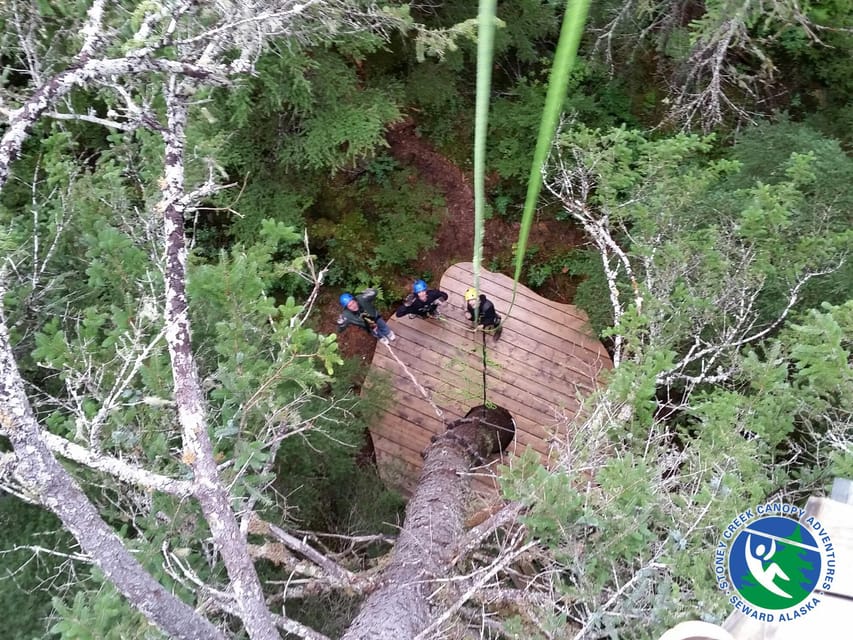
The final traverse crosses above the tour parking lot and passes the welcome-center yurt. It ends among Sitka spruce, where a 40-foot rappel brings you back to the ground.
That last rappel gives the activity a proper finish. Instead of stepping off at the final platform and walking away, you return to earth by rope. After removing your helmet and harness, you head back to the welcome center to collect belongings and look at photos taken during the tour.
You may bring a camera or phone, but you must have a way to secure it to yourself. A loose phone is not suitable for a zipline course, and selfie sticks are not allowed. Backpacks and bags are also prohibited, so plan to travel light.
What the $179 price buys you
At $179 per person, this is not a budget activity. The price includes the guides, water, transport from the Seward harbor area, the full canopy course, and views of the mountains and forest. You are paying for more than individual zipline rides: the fee also covers instruction, equipment use, the forest drive, platforms, bridges, and rappels.
The value depends on what you want from a Seward excursion. If you only want a quick zipline, the cost may feel high for 2.5 hours. If you want a structured outdoor activity with eight lines and several types of challenges, the price is easier to justify.
The small group improves the value. A maximum of eight people means the guides can spend time on technique and help the group progress together. It also reduces the chance that the day will feel like standing in line for one short ride after another.
Photos are available to view and select after the tour, but they are not listed as included. You should plan on an additional charge if you want them. Water is included, but food and drinks are not allowed on the course.
Free cancellation is available up to 24 hours before the activity for a full refund, and you can reserve now and pay later. The tour operates rain or shine, so your clothing choice matters more than the forecast alone.
Clothes, physical requirements, and comfort
Wear comfortable clothing and closed-toe shoes. Open-toed shoes are not allowed, and you should choose clothes that let you move your shoulders and arms freely.
The requirement to raise your hands and arms completely above your head is strict, with no exceptions. This movement is important for riding, braking, and handling the course. The tour is not suitable for people with back problems or pregnant women.
The stated weight limits are 88 to 270 pounds, or 40 to 122 kilograms. Children under 10 cannot participate. People who are afraid of heights should also choose another Seward activity, since the course includes platforms as high as 75 feet, a 60-foot walkway ending above the forest, and two rappels.
Smoking, alcohol, drugs, chewing gum, headphones, food, and drinks are not allowed. These rules may seem fussy, but they keep your hands, attention, and equipment where they need to be.
The tour runs in rain, so bring a rain-ready attitude. The provided information does not promise dry weather or indoor alternatives. You should expect the forest to look and feel different in wet conditions, and dress for comfort rather than relying on perfect skies.
Who will enjoy this course most
I would recommend Stoney Creek Canopy Tour to active visitors who want a strong mix of scenery and controlled adventure. It suits a family with older children, a couple looking for a memorable outdoor activity, or a small group that wants something more physical than a standard viewpoint stop.
The activity is particularly good for people who value variety. You get eight ziplines, but the course also includes three bridges, two rappels, a forest drive, high platforms, and changing views of the valley. The design keeps you from doing the same motion for the full 2.5 hours.
It is less suitable if you want a quiet nature walk, if you dislike heights, or if you need a flexible pace. You must follow the group schedule, ride in the van at set times, and take part in the safety training. The tour is in English, and the supplied information lists no other language option.
The course also demands a basic level of physical confidence. You do not need to be an athlete based on the information provided, but you must meet the weight limits, raise your arms fully, walk between course elements, and manage the rappels.
Should you book the Stoney Creek Canopy Tour?
Book it if you want to see Seward’s forest from unusual angles and you are happy to trade a relaxed outing for a structured challenge. The strongest reasons are the 1,100-foot line, the view toward glaciers, the old-growth Pacific forest, and the unusual combination of ziplines, bridges, and rappels.
Skip it if heights make you uncomfortable, if you need dry-weather certainty, or if your plans cannot accommodate the early check-in and fixed van departure. At $179, it is best viewed as a major half-day activity, not a small add-on.
For the right person, the course offers a clear progression: practice close to the ground, rise into the spruce trees, cross the valley wall, descend through the forest, and finish with a rappel beside the welcome-center yurt. That changing rhythm is what makes this more memorable than a basic zipline ride.
FAQ
Where does the Stoney Creek Canopy Tour begin?
You meet at the Adventure Center in the Seward Small Boat Harbor. A Stoney Creek Canopy Adventures van takes you from there to the course.
How long does the experience last?
The tour lasts about 2.5 hours. The van leaves from the Adventure Center 30 minutes before the scheduled tour time, and check-in is required 45 minutes before the tour.
How many ziplines are included?
The course includes eight ziplines. They vary in length and height, including a 65-foot opening line, a 1,100-foot line over a reflecting pond, and a 280-foot line near the end.
How many bridges and rappels are included?
You cross three suspension bridges and complete two rappels. The described rappels are 60 feet and 40 feet.
What should I wear?
Wear comfortable clothing and closed-toe shoes. Open-toed shoes are not allowed.
Can I bring my phone or camera?
You may bring a phone or camera if you have a way to secure it to yourself. Selfie sticks, backpacks, and bags are not allowed.
Is the tour suitable for children?
The tour is not suitable for children under 10 years old. Participants must also meet the stated weight range of 88 to 270 pounds and be able to raise both arms fully above their heads.
Does the tour operate in bad weather?
The tour takes place rain or shine. You should wear comfortable clothing suited to changing weather conditions.
Fresh zipline picks around the USA
- Hakalau: 9-Line Zipline Adventure with Umauma Falls View★ 4.5 · 7 reviews
- Twin Falls: Zip Line Tour★ 4.1 · 8 reviews
- Tree Tops Zip Line Canopy Tour★ 5.0 · 32 reviews
- New River Gorge, WV – Zip Line Tour★ 5.0 · 7 reviews
- Zipline Canopy Tour- ArborTrek at Smugglers Notch Resort★ 5.0 · 9 reviews
- Wildman Zip Line Tour★ 5.0 · 10 reviews
- Zipline and Adventure Tower at Ryze Adventure in Missouri★ 5.0 · 4 reviews
- Zipline the Goliath in The Smoky Mountains★ 5.0 · 5 reviews
More USA Zipline Tours to compare.
Oahu’s North Shore: 8-Line Zipline Adventure
Read our review →
Maui Zipline Eco Adventure: 8 Lines through the Jungle
Read our review →
Big Island Zipline Tour Near Akaka Falls (250-ft Waterfall!)
Read our review →
Big Island: 9-Line Waterfall Zipline Experience
Read our review →Zipline lists with this tour